

Coody Dog Tent
Coody Dog Tent
Regular price
€189,00 EUR
Sale price
€189,00 EUR
Regular price
UVP
Taxes included. Shipping calculated at checkout.
Pre-order
Orders placed in September are expected to be delivered mid to late November 2026.
Quantity
Matching accessories
Couldn't load pickup availability
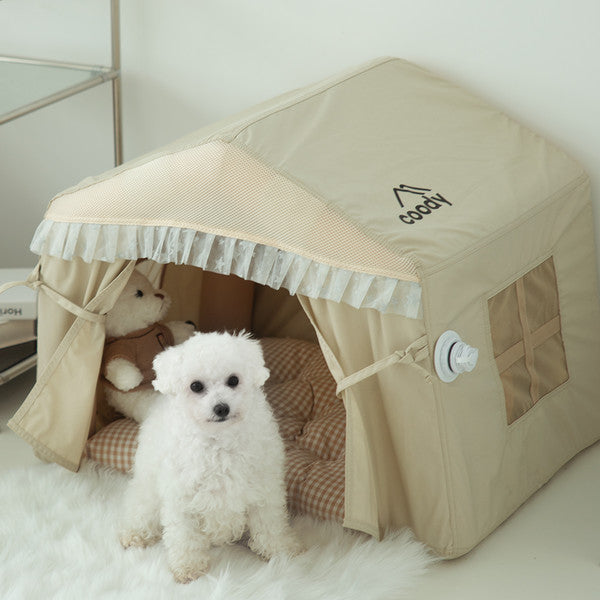
The Coody Pet Tent gives your pet a cosy retreat – at home, in the garden or while camping. The inflatable construction, high-quality materials and the typical Coody design make it the perfect little tent for dogs and cats.
Highlights
- Unique Coody camping-tent design
- High-quality cotton blend fabric
- Light weight of only 1.6 kg
- Ideal for living spaces and sheltered indoor areas
- Stylish design in natural beige
- Easy to set up and flexible to place
Technical data
Technical data
Dimensions & Weight
Dimensions & Weight
Packaging dimensions
Packaging dimensions
Scope of delivery
Scope of delivery
Manufacturer information
Manufacturer information
Coody Co., Ltd.
Gyeongsangnam-do,
Changwon, Masan Hoewon-gu,
Nae-seo-eup, Sinpyeong-ro 35-2,
(주)쿠디, South Korea
+82 70-8803-6981
Responsible person
Responsible person
E-Market Bridge GmbH
Käthe-Kollwitz-Str. 2A
31157 Sarstedt
Email: info@coody-camping.de
User manual
User manual
Safety instructions
Safety instructions


Preparation and setup
- Always set up the tent on elevated ground, away from trees with heavy snow loads or open fire sources.
- Make sure there is adequate distance from water sources and rivers.
- Avoid setting up on slopes or uneven terrain.
Operating temperature
- Suitable for outdoor use in a temperature range of -15 °C to +40 °C.
- PVC hardens at sub-zero temperatures – the base and supports become stiffer, making folding more difficult. This is normal.
- Use sleeping bags with the appropriate temperature rating and place additional insulating mats underneath for added comfort.
Heating and insulation
- A roof vent for a wood-burning stove is available. Only stoves with spark guards may be used. Safe electric heaters are permitted. Open flames are not allowed.
- Ensure adequate ventilation to prevent the build-up of carbon monoxide.
- Use the internal partition (if available) to keep the heat in the sleeping area.
- Keep TPU windows closed to retain heat; open them only briefly for ventilation.
- Improve insulation by placing carpets, blankets, or mats on the floor.
Air pressure and poles
- Air pressure drops in freezing temperatures – check it regularly and pump up if necessary.
- Make sure that all valves are completely and correctly closed.
Condensation and moisture
- Condensation is normal and comparable to fogged windows. The higher the waterproofness of the material, the less breathable it is, which can increase condensation.
- Good ventilation is the best way to reduce condensation.
Protection from rain and snow
- The tent withstands moderate rain for about 4–5 hours. In light or occasional rain the rainfly is not strictly necessary.
- In prolonged rain, always use the supplied rainfly.
- Remove the rainfly after rainfall to improve air circulation and avoid condensation.
- Pre-attach or roll up the rainfly on one side so it is quickly to hand in continuous rain.
- Fit the rainfly immediately when it snows. Accumulated snow increases the moisture load.
- Clear snow from the tent roof regularly.
- If zips freeze, thaw them gently by hand or with warm water – never force them open.
- After winter use, let the tent dry completely before storing it.
Folding and storage
- Cold temperatures make PVC and fabric stiff, making folding more difficult.
- Fully ventilate the tent before packing it away.
- Allow the tent to dry completely in a well-ventilated place and store it only in a dry place.
Care and maintenance
- Do not wear boots or shoes indoors.
- Keep sharp or pointed objects away from walls and floors.
- Do not place the tent near chemicals or flammable substances.
- Mold and prolonged UV exposure shorten the lifespan – keep the tent clean and protected.
- Reduce direct sunlight; use the rain cover if necessary.
Fire protection measures
- Use electrical appliances carefully and properly.
- Keep the entrance clear at all times so that the emergency exit remains accessible.
- Keep a fire extinguisher or suitable extinguishing agent nearby.
- Keep fireworks and similar items away from children and the tent.


